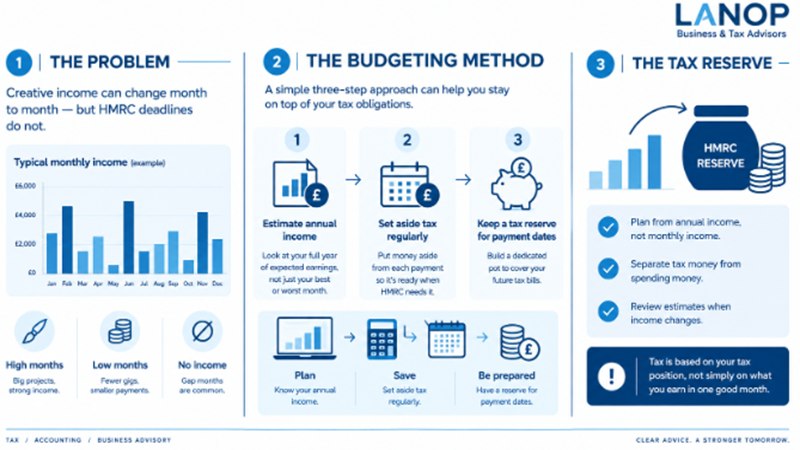
£500 one month, £2,000 the next and then £8,000, before not much follows. Creatives understand the unpredictability of money, and so do the best accountants for creatives. The real challenge isn’t calculating what is due to HMRC.it is having the cash ready.
This guide offers a workable system: estimate your liability, keep your tax money separate from everything else, prepare for January and July, build a buffer to deal with slow-income months, and update your plan if income suddenly jumps or falls.
Why does irregular creative income make tax budgeting so hard?
The act of earning doesn’t equal cash flow. A wedding photographer may bank most of a year between May and September. A designer lands one major branding job. A writer receives an advance, followed by a long dry spell.
A check from a client doesn’t automatically equal a spendable amount. Tax, business costs, VAT where appropriate, the quiet months ahead and your own living costs all need a share.
Your income is inconsistent, and your tax due dates are not.
What does HMRC actually tax?
HMRC doesn’t have your clients’ money in mind when setting your liabilities. They start with revenue, remove expenses, and tax the resulting profit. A £10,000 project therefore does not produce £10,000 of taxable profit unless legitimate business costs happen to leave it untouched, subject to the rules.
It also takes into account your wider position: other income, tax bands, National Insurance, student loan repayments, pension contributions and what you’ve already paid.
Why can your January bill be so much bigger than expected?
January can involve two payments at the same time: the balancing payment, for the year that’s just ended, and the first payment on account, an advance towards next year’s bill and not an additional tax. Where they apply, each is usually half of the previous year’s liability, with the second falling due in July.
This hits creatives hardest. They enjoy a great year, a big commission, then a month of slow work, before tax time rolls around again. Payments on account from the larger year can leave them paying more than they expected to have paid.
What if your income falls after a very good year?
Why has a higher liability landed just as you’re trying to save? Payments on account always refer to the previous year’s tax position, not the one you’re in now.
So if you reasonably expect a lower tax bill this year, you might be able to ask for a reduction. But cut it too deep and you could face a larger balancing payment, with possible interest on the shortfall. Being realistic about your liability is fair game; using forecast figures to lighten the load on one you know is not.
How much should you set aside?
There’s no simple “save 30%” guideline. It depends on your projected taxable profit, allowable expenses, other employment income, tax bands, National Insurance, student loan repayments, pension contributions and what you’ve already paid.
Always save from profit rather than turnover expenses, reduce what you’re taxed on and build a reserve: an estimate of annual tax liability, minus tax you’ve already met, gives you the sum to put aside.
Take a photographer who received £8,000 for a campaign. Here’s one example of how the money might break down:
Where the £8,000 goes Example
Business costs £1,500
Tax reserve £1,500
Slow-month buffer £1,500
Personal income £3,500
Should you save tax from every payment, or monthly?
Either way works with lump sum income, but a regular monthly saving makes personal budgeting simpler.
Why keep tax, buffer and everything else apart?
One pot disguises the truth. Anyone finding £6,000 in savings suddenly realises £3,500 of it belongs to HMRC.
Pot Purpose
Tax reserve Future HMRC payments
Business account Operating costs
Slow-month buffer Uneven income
Emergency fund Unexpected personal costs
Personal spending Living costs
Design your lifestyle around your smallest guaranteed income, not your highest month.
What if a client pays late?
You may raise an invoice in March and get paid in April. Cash basis accounting, an option for many sole traders, generally means income is taxed when it arrives rather than when you send out invoices. Set payment terms, deposits, staged invoices and track what’s unpaid.
Smaller questions that trip creatives up
Expenses: deduct costs with a genuine business purpose, such as software, equipment where allowable, studio costs and relevant travel. Claiming lowers your taxable profit, but doesn’t make the purchase free.
PAYE plus creative income: PAYE won’t always cover the whole amount. Freelance profits can push you into a higher tax band, and Self Assessment may apply.
Profit averaging: qualifying creators of literary or artistic works may average profits, thanks to specific rules. Eligibility isn’t automatic, so consider it.
Limited company: Incorporation doesn’t solve irregular cash flow. It might be worth exploring when profits are consistently higher.
VAT: The VAT you collect isn’t your income, so keep it in a separate pot.
What should your tax year look like?
April to June: review last year, estimate this year’s income and build your reserve.
July: pay the second payment on account and review estimated profit.
August to December: keep saving and assess big projects.
January: prepare for balancing and first payment on account.
February to March: rebuild the reserve and estimate next year’s tax bill.
Each month involves recording payments, estimating your liability, ring-fencing tax money and paying yourself.
When should you speak to an accountant?
When income jumps or plummets, or comes from multiple sources, as well as if you also hold a PAYE job. Ask about doubtful deductions, payments on account and averaging, or consider a limited company. Good accountants for creatives forecast your January balance early and tell you what to save. That’s the work we do at Lanop .
Frequently Asked Questions
How much should I save for tax if my income changes every month?
No one-size-fits-all percentage applies. Base calculations on your taxable profit and wider position, and top up the reserve whenever you receive a payment. Update it after a major project.
Do I pay tax twice in January?
Not quite. The balancing payment settles last year’s tax, while the first payment on account is an advance on next year’s liability. Both arrive in January, which is why it feels like paying twice.
Can I reduce my payments on account?
If you genuinely expect a smaller liability, then yes, these can be lowered. But reduce them too far and you may face a larger balancing payment and possibly pay interest on the unpaid amount. Forecast responsibly, and don’t overstate savings when preparing your return.
Should I save tax from turnover or profit?
Profit is a safer guide, since expenses deducted reduce taxable amounts. Always allow a margin of error.
What if my client pays me months after I send the invoice?
Under a cash basis, income generally counts when you receive it rather than when you invoice. That impacts tax timing, but late payments still create cash flow challenges. Build a buffer and chase late invoices.
Conclusion:
You cannot control when freelance work pays you, but you can choose how to prepare. View HMRC deadlines as regular expenses, keep pots separate and forecast year-round.
The goal is to smooth cash flow, not create regular income from unpredictable work. If you’d like help building such a system, accountants for creatives like Lanop Business & Tax Advisors can set it up.